

Table of Contents
Quick answer
Start a COA review by matching the product reference, formulation and lot to the purchase order and received labels. Then check results against the applicable specification and method. A batch report does not establish market authorization or replace the manufacturer’s release controls.
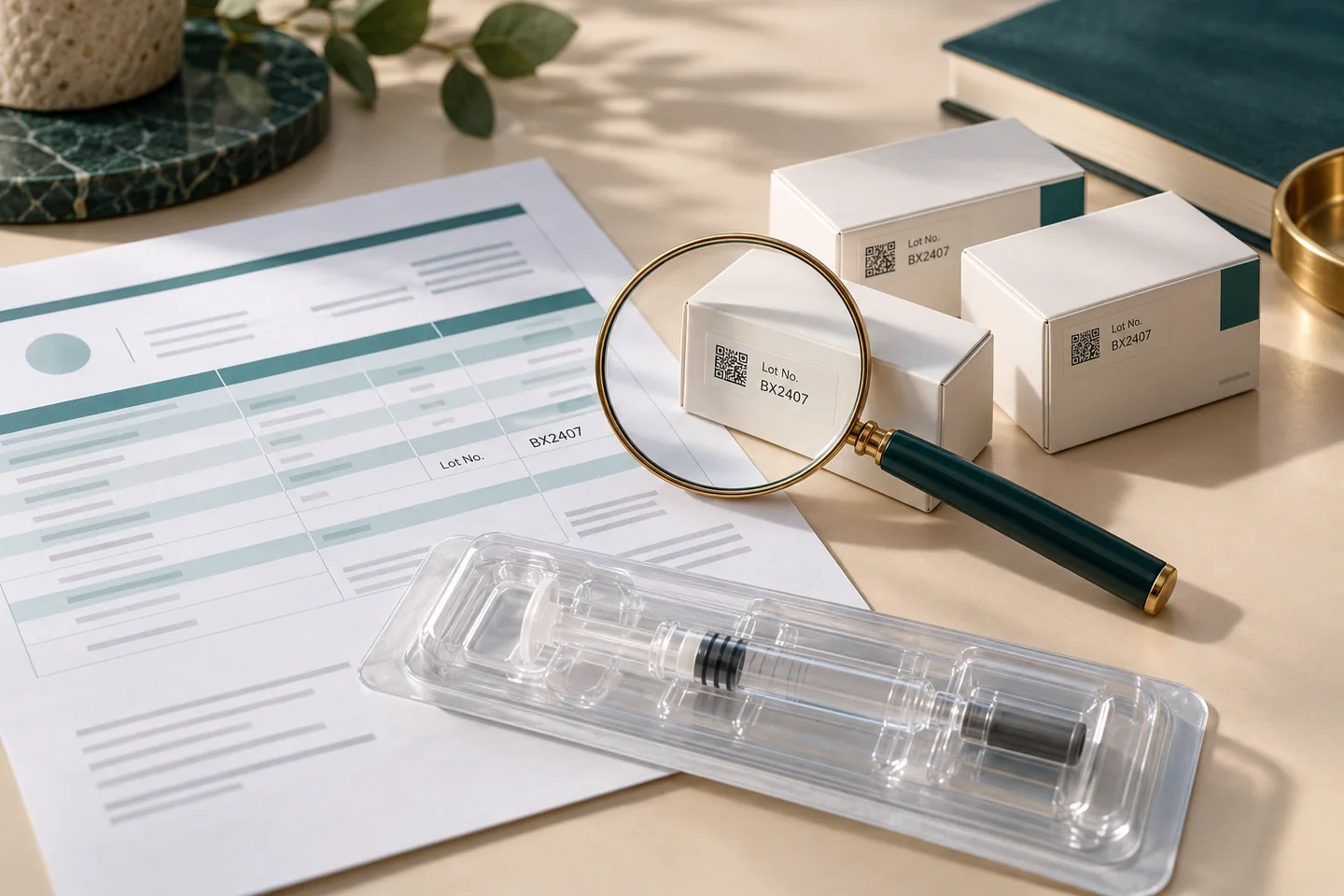
A shipment can arrive with a polished laboratory report and still leave the buyer unable to answer a basic question: does this document describe these units? A model suffix, a batch code or an attachment can be missing even when every visible result says “pass.”
For a distributor reviewing a dermal filler certificate of analysis (COA) and receiving HA dermal fillers, a useful COA review therefore begins with reconciliation. The workflow below is an editorial purchasing framework. The actual release specification and testing obligations remain specific to the product, manufacturer and destination market.
Which identifiers should match on a dermal filler COA?
Match the exact product reference and lot first. Compare the purchase order, unit label, outer carton, packing list and report. Where the supplier uses different internal and commercial codes, request a documented cross-reference rather than deciding that similar names must describe the same formulation.
Keep an intake record with the ordered model, concentration as labelled, package format, received quantity and each lot number. A 1 mL syringe and a multi-unit carton are different counting units; an unexplained quantity difference can be a packing convention or a shipment discrepancy. Establish which before changing inventory.

If the report identifies bulk gel while the shipment contains finished syringes, ask how the bulk batch connects to the filling and packaging lots. That question does not imply the document is false. It identifies the missing link needed to interpret it.
What makes a test result usable for purchasing review?
A result needs its acceptance criterion, unit and method context. “Conforms” can be appropriate for some attributes, but it should refer to a controlled specification rather than an undefined supplier expectation. A numeric entry without its unit is not a comparable result.
| Report item | Buyer’s check | Follow-up when unclear |
|---|---|---|
| Product and lot | Same identity as received stock | Request the lot cross-reference |
| Specification | Identified document and revision | Ask which revision governed release |
| Quantitative result | Unit, limit and reported value | Clarify missing units or reporting basis |
| Qualitative result | Defined criterion and method reference | Ask what “pass” means for that attribute |
| Issue and authorization | Traceable issuing organization and release status | Verify through a known supplier contact |
Do not create your own universal limits for endotoxin, residual substances or other product attributes from another supplier’s sheet. The FDA’s pyrogen and endotoxin testing guidance discusses methods, acceptance criteria and product-specific considerations. A limit detached from its intended application and method is not a sound purchasing shortcut.
Does a COA establish sterility or market authorization?
The report supports only the attributes and batch scope it actually documents. It is not a product license. Nor should a buyer treat a short microbiology entry as a replacement for the manufacturer’s validated production and sterilization controls.
FDA’s sterility information guidance for devices labelled sterile addresses information submitted in a particular US regulatory pathway. It is a useful example of why the process, packaging and evidence matter together; it does not mean every aesthetic product follows that pathway.
For market-access review, keep a separate file connecting the legal manufacturer, exact device and intended market to applicable authorization documents. For packaging condition, use a separate sterile barrier receiving check under a defined procedure. Combining these different checks into a single “certificate received” checkbox hides what remains unverified.
How should you resolve a mismatch without losing the audit trail?
Record the discrepancy before asking for a replacement file. An effective request identifies the received lot, the conflicting field, the source documents and the clarification needed. Avoid a vague request to “send a better COA,” which can produce another document without resolving the original inconsistency.
For example, if the received carton shows lot A and the report shows lot B, retain both originals and request either the correct report or a documented explanation. Do not edit the batch code on the PDF yourself. When a correction arrives, retain the revision history and record who resolved the mismatch.
The final receiving decision should name the lot and quantity it covers, any remaining conditions and the person or function authorized to release inventory under your procedure. This turns the COA from an email attachment into evidence that can be retrieved during a later complaint or supplier review. Use the broader supplier evaluation checklist for company-level assessment; this lot-level review serves a different decision.
Frequently Asked Questions
Should a COA disclose every confidential manufacturing detail?
Not necessarily. Agree the information needed for your purchasing and quality review, including product identity, specification references, relevant results and document authenticity. Confidential technical details may require controlled access rather than a public report.
Can one report cover a shipment containing several lots?
Only if the documentation clearly identifies each included lot and the results or release records applicable to it. Record the quantities received for each lot; do not assume a report for one lot covers the others.