

Table of Contents
- 1. Why Do Most Aesthetic Medical Supplier Evaluations Fail Before the Order Is Placed?
- 2. The 10-Point Technical Sourcing Checklist for Injectable Medical Devices
- 1. ISO 13485:2016 Scope Authenticity
- 2. CE Certificate & Notified Body Authorization
- 3. Batch-Specific Certificate of Analysis (CoA)
- 4. Cleanroom Classification & Environmental Monitoring
- 3. Comparative Supplier Evaluation Matrix: Auditing Risk Tiers
- 4. How Should Importers Assess Cold-Chain Logistics and Transit Controls?
Quick answer
A supplier is only as reliable as the documentation it will put in writing. Ask for the ISO certificate with its scope text, a batch-specific Certificate of Analysis with numerical results, and a sample from current stock before you commit. Unwillingness on any of those three is the signal that matters most.
Why Do Most Aesthetic Medical Supplier Evaluations Fail Before the Order Is Placed?
Most supplier relationship failures happen before the first purchase order is issued — not after the goods arrive. Clinic directors and medical procurement teams often rely on glossy marketing brochures, polished website photography, or aggressive pricing discounts instead of auditing the manufacturer’s actual quality management infrastructure.
In medical aesthetics, procuring from an unverified supplier creates four severe risks:
- Regulatory Seizure: Customs clearance failure due to non-compliant documentation or missing Notified Body approvals.
- Clinical Complications: Unacceptable endotoxin levels (
> 0.5 EU/mL) causing late-onset sterile granulomas and patient dissatisfaction. - Rheological Inconsistency: Extreme lot-to-lot variance in G-prime, extrusion force, and duration.
- Supply Chain Disruption: Unpredictable production delays and abrupt factory stockouts.
The following 10-point technical checklist is used by international medical device buyers to separate genuine cleanroom manufacturers from brokers and grey-market traders.
The 10-Point Technical Sourcing Checklist for Injectable Medical Devices
1. ISO 13485:2016 Scope Authenticity
Request the official ISO 13485:2016 certificate as a high-resolution PDF.
- Confirm the standard version is ISO 13485:2016 (not obsolete 2003 or 2012 editions).
- Read the Scope Statement: It must explicitly reference your device category (e.g. “Design, development, cleanroom filling, and terminal sterilization of sodium hyaluronate dermal implants”).
- Verify registrar accreditation via the IAF CertSearch portal or the issuing body (BSI, TÜV SÜD, SGS, Intertek).
2. CE Certificate & Notified Body Authorization
For sterile Class IIb / Class III implants, confirm:
- A valid 4-digit Notified Body number is present.
- The certificate is verified against the EU NANDO directory.
- The manufacturer facility address matches the cleanroom production site.
3. Batch-Specific Certificate of Analysis (CoA)
Never accept a static “Product Specification Sheet” in place of a CoA. A compliant batch CoA must document:
- Batch/Lot number matching the physical syringe labels.
- Actual measured numerical values for pH, osmolality, G’, and residual BDDE (
< 2 ppm). - Kinetic chromogenic LAL endotoxin test results (
< 0.5 EU/mL). - A dated signature from the QA Director.
4. Cleanroom Classification & Environmental Monitoring
Inquire about the factory’s environmental classification:
- Formulation and syringe filling must take place in an ISO Class 5 (Grade A / Class 100) laminar air flow zone within an ISO Class 7 (Grade C / Class 10,000) cleanroom environment.
- Ask for recent bioburden and airborne particulate count logs.
Comparative Supplier Evaluation Matrix: Auditing Risk Tiers
Use the scorecard below to evaluate prospective aesthetic device manufacturers across 6 core capabilities:
| Evaluation Dimension | High-Risk Supplier (Disqualify) | Acceptable Tier-2 Supplier | Gold Standard Partner (AestiSource Audited) |
|---|---|---|---|
| QMS Certification | No ISO 13485 or vague general ISO 9001 scope | Valid ISO 13485:2016 from national registrar | Accredited ISO 13485:2016 with comprehensive cleanroom scope |
| Regulatory Standing | Self-declared CE without Notified Body code | CE under MDD transition extension | Full EU MDR 2017/745 Class III CE with Notified Body designation |
| CoA Transparency | Generic sheet stating “Pass / Complies” | Numerical values with minor omissions | Full batch report with GC-MS BDDE and LAL endotoxin testing |
| Sample Policy | Refuses samples or charges exorbitant fees | Lab prototype sample with delayed lead time | Routine production stock sample with lot-specific CoA |
| MOQ & Flexibility | Rigid 1,000+ units minimum with no trial order | 200–500 units with standard payment terms | Tiered MOQ (from 10–50 boxes for clinics) + custom OEM tiers |
| Cold Chain Packaging | Standard uninsulated cardboard shipping | Polystyrene box with basic gel ice packs | Validated thermal packaging with real-time temperature data-loggers |
Looking for pre-vetted, ISO 13485-certified aesthetic manufacturers?
AestiSource audits factory cleanrooms, inspects lot sterilization records, and provides comprehensive factory verification dossiers for aesthetic clinics.
How Should Importers Assess Cold-Chain Logistics and Transit Controls?
While most cross-linked HA hydrogels are labeled for storage at 2°C to 25°C, international air freight exposes shipments to extreme temperature spikes (e.g. tarmac transshipment in Dubai, Singapore, or Frankfurt reaching 45°C+).
- Thermal Excursion Risk: High temperatures accelerate the thermal degradation of cross-linked HA, lowering G-prime and viscosity before the product ever reaches the clinic.
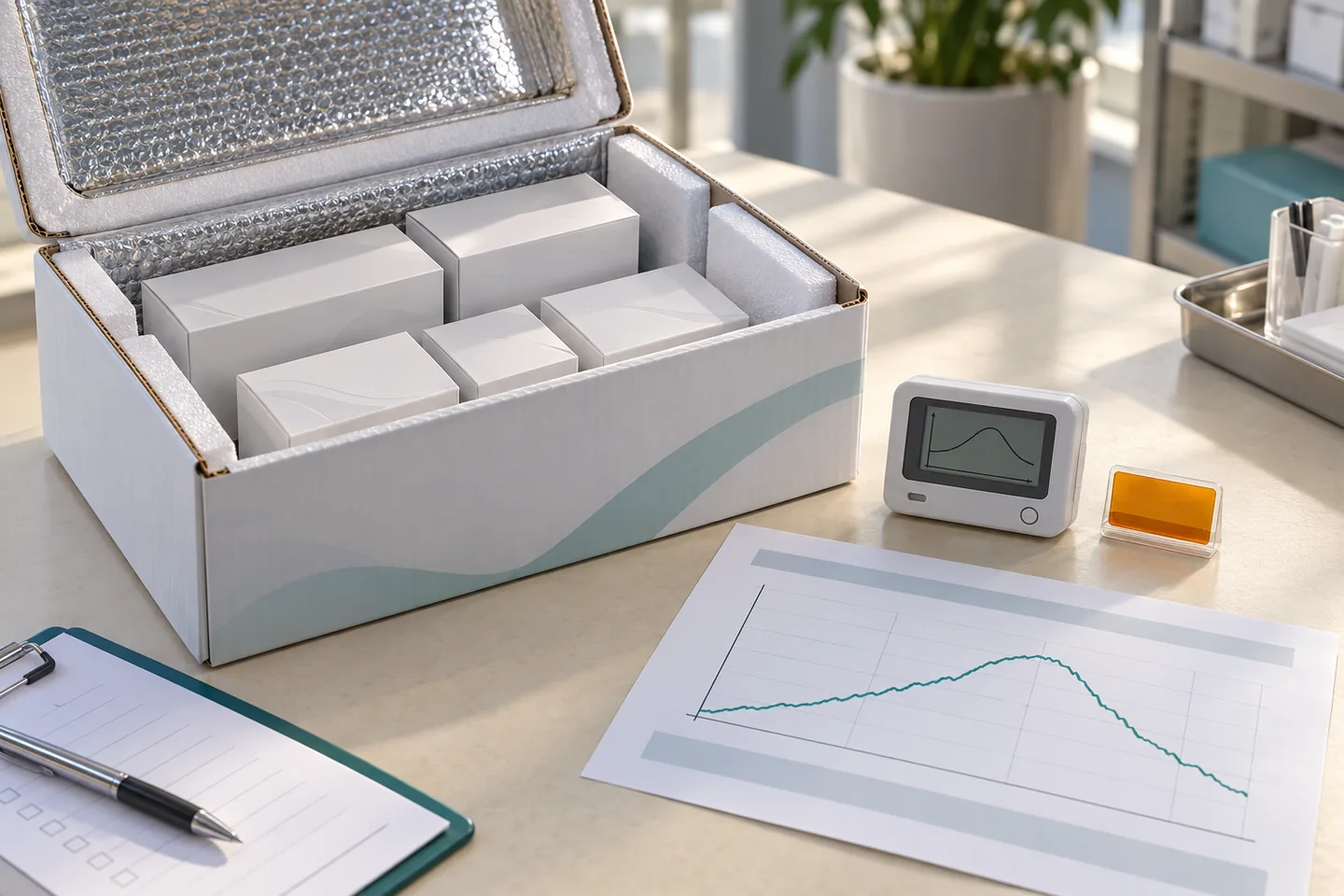
- Packaging Requirement: Require insulated EPS / VIP shippers with phase-change materials (PCM).
- Data Loggers: For high-value wholesale shipments, demand single-use USB or Bluetooth temperature data-loggers packed inside the core shipping shipper to document continuous thermal compliance upon customs arrival.
Frequently Asked Questions
What ISO certification is minimum for a dermal filler supplier?
ISO 13485:2016 with scope text explicitly covering your product category — for example, 'Design, development and manufacture of sterile injectable hyaluronic acid dermal fillers.' A certificate with vague scope (e.g. 'provision of quality management documentation') does not confirm sterile manufacturing compliance. Always verify the certificate number against the issuing registrar's online portal.
What must a genuine batch Certificate of Analysis (CoA) contain?
A genuine CoA includes: product name and order code, unique production lot number, manufacturing and expiration dates, each specification parameter with its upper/lower limit alongside actual measured laboratory values, sterility test method, and a dated quality release signature. If the document displays only 'Pass' or 'Complies' without numerical test data, it is merely a specification sheet, not a batch CoA.
How do I know if a supplier CE certificate is genuine?
Check for the 4-digit Notified Body number on both the retail packaging and the certificate document. The four-digit number identifies the independent body that audited the manufacturing cleanrooms. Verify it in the EU NANDO database. A CE mark without a Notified Body number on sterile injectables indicates an unauthorized self-declaration, invalid for Class IIb or Class III medical devices.
Is a supplier unwilling to provide commercial samples a red flag?
Yes. An authentic, high-volume manufacturer actively encourages sample evaluation from current production stock because it builds clinical trust and prevents post-shipment disputes. Reluctance to provide samples usually signals broker/trader status, lack of finished goods inventory, or fear of independent rheological testing.
What is the minimum documentation required for importing aesthetic medical devices?
A standard import documentation package includes: commercial invoice with correct 6-digit HS codes, packing list with gross/net weights and lot numbers, Certificate of Origin, ISO 13485 certificate copy, CE certificate or regional health authority approval, Certificate of Free Sale (CFS), batch-specific CoA, and non-dangerous goods air transport classification documentation.