

Table of Contents
Quick answer
Set a minimum remaining-life requirement at a defined receiving point, using downstream acceptance needs, handling time and planned stock cover. Compare actual lot expiry dates against that threshold. The calculation is an inventory tool; it cannot extend the labelled expiry or override storage requirements.
An attractive unit price can become an expensive order if the lot reaches the warehouse with too little time left for normal distribution. The product may still be within its labelled expiry, yet a downstream customer may refuse it under an agreed remaining-life policy.
Dermal filler shelf life here means the labelled storage period of unopened stock, not the duration of a treatment result. The remaining-life requirement is a planning problem that should be resolved before the purchase order. It is different from deciding how the manufacturer establishes the product’s shelf life.

Which dates should the buyer distinguish?
Separate the labelled expiry, the estimated receipt date and the downstream customer’s acceptance point. State whether a remaining-life promise is measured at dispatch, arrival at a port or receipt at your warehouse. Those milestones are not interchangeable.
FDA’s shelf-life guidance for medical devices discusses the period during which a device remains within acceptable specifications. FDA also explains in PMA special considerations that labelled expiration dating must be supported by stability testing and the labelled storage conditions in that context. A buyer’s inventory calculation does not establish or lengthen that period.
For purchasing, request proposed lot expiry dates when stock allocation becomes available. A statement that a product normally has a long shelf life from manufacture does not answer how much time remains on the offered lots.
How can you set a minimum remaining-life threshold?
Work backward from the final commercial handoff, allowing for the time the stock will spend in your own operation. Use assumptions specific to the order and identify any uncertainty.
The following is a deliberately hypothetical planning example, not a product specification or regulatory rule:
- The downstream buyer requires at least six months remaining at its receipt.
- Planned stock cover before downstream dispatch is two months.
- Handling, onward transport and a commercial contingency total one month.
- The resulting purchasing threshold is at least nine months remaining at your warehouse receipt.
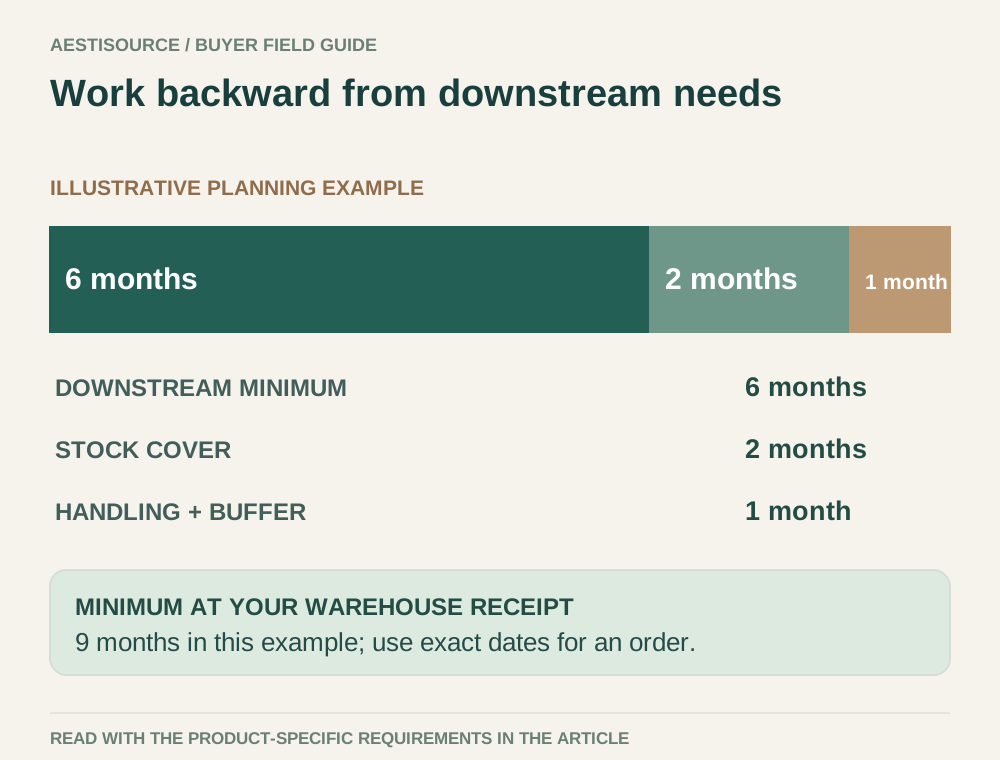
Use exact calendar dates for an actual order. “Nine months” is an early planning shorthand; it should become an agreed earliest acceptable expiry date relative to the intended receiving date. Avoid converting all months to a fixed number of days unless that convention is explicitly agreed.
What happens when one order contains several expiry dates?
Evaluate each lot separately. A blended average hides the short-dated portion and can make an unsuitable allocation appear acceptable.
| Proposed allocation | Receiving review | Planning action |
|---|---|---|
| All lots meet the agreed threshold | Reconcile quantities and dates | Allocate to normal inventory plan |
| One lot falls below the threshold | Identify its exact quantity | Request a different allocation or assess a documented exception |
| Lot dates are not yet assigned | Remaining life is unconfirmed | Make confirmation a pre-dispatch condition |
| Arrival is delayed | Recalculate at the new receiving date | Reassess downstream feasibility |
If a limited exception is commercially reasonable, define the specific lot, quantity and destination. Do not change the standing policy silently, or the next shipment may arrive on the assumption that the shorter window is now acceptable.
How does FEFO support dermal filler inventory management?
First-expiry-first-out is a way to sequence eligible inventory by expiry date. It does not replace the release status or the customer’s acceptance criteria. A lot with unresolved storage history should not be moved ahead simply because it expires sooner.
Keep lot, expiry, quantity and inventory status searchable across receiving and dispatch records. Then compare dispatch proposals with the intended customer’s remaining-life requirement. When a shipment is split, preserve the lot allocation for each portion so a later reconciliation can explain which dates went where.
Returns require their own review. Re-entering a returned unit under the original SKU without checking status and history can undermine a carefully planned rotation system.
Negotiate the threshold alongside order quantity
A larger order can reduce unit price while extending the time needed to sell through stock. Compare both effects rather than discussing the discount alone. If demand is uncertain, staged releases or smaller lots may be worth evaluating, subject to supplier terms and the actual product configuration.
The MOQ and lead-time guide covers production planning inputs. Add a separate remaining-life clause to that discussion: the measuring milestone, minimum requirement, lot disclosure point and process for delayed or nonconforming shipments. That gives both sides a measurable commercial expectation without inventing a new medical shelf-life claim.
Frequently Asked Questions
Can a short-dated batch be accepted if the price is lower?
Only if it meets your applicable quality, storage and downstream acceptance requirements. Model the usable sales window and potential unsold units explicitly; a discount does not change the labelled expiry.
Should FEFO ignore a stock hold?
No. First-expiry-first-out applies to eligible stock. Units on quality hold, with unresolved identity or with unsuitable handling history must not be dispatched simply because their expiry is earlier.
Products referenced in this guide
Sources
- Shelf Life of Medical Devices — U.S. FDA (1991-04)
- PMA Special Considerations — U.S. FDA