


Table of Contents
Quick answer
Compare quotes at the same named destination and delivery scope. Add only costs not already included, separate recoverable taxes from economic cost, and divide by the relevant usable quantity. Incoterms allocate delivery obligations, costs and risk; they do not replace product-quality, payment or market-access terms.
Supplier A quotes a low factory unit price. Supplier B quotes a higher figure with transport to a named destination. Comparing the two numbers without their scope does not reveal which offer costs less to receive.
A useful landed-cost worksheet places both offers on the same basis and keeps uncertain items visible. For aesthetic product purchasing, it should also preserve the distinction between a transport price and the evidence needed to import and release the product.
What do Incoterms tell you about landed cost?
The ICC’s Incoterms 2020 framework defines trade terms used to allocate delivery obligations, costs and risk. The exact rule and named place matter. A three-letter term without a precise location leaves the quotation incomplete for comparison.
ICC also explains that Incoterms do not replace a sales contract addressing matters such as payment and quality, and do not settle ownership transfer by themselves. Keep those terms explicit rather than trying to infer them from the shipping abbreviation.
For each quote, record the rule, version, named place and the seller’s stated inclusions and exclusions. Then ask the freight provider or broker to clarify the missing legs and charges for that specific transaction.

Which cost lines should be normalized?
Start with the product price and add only items not already included. Double-counting transport or handling can distort a comparison as much as omitting it.
| Worksheet line | Information to obtain | Common ambiguity |
|---|---|---|
| Product | Quantity, unit of sale and currency | Syringe price versus carton price |
| Origin charges | Export handling and local movement where applicable | Included in quote or billed separately? |
| Main transport | Mode, route and service scope | Airport arrival versus final delivery |
| Insurance or cover | Scope, exclusions and payer | Freight price mistaken for full coverage |
| Destination costs | Brokerage, inspection, handling and storage | Charges left as “at actuals” |
| Duties and taxes | Verified classification and local treatment | Estimated rate presented as confirmed |
| Local delivery | Final named receiving point | Delivery to terminal mistaken for warehouse receipt |
Record the evidence date beside each estimate. Freight quotations, exchange rates and handling charges can change, so an old worksheet should not be reused as if every input were fixed.
How does a simple worked example behave?
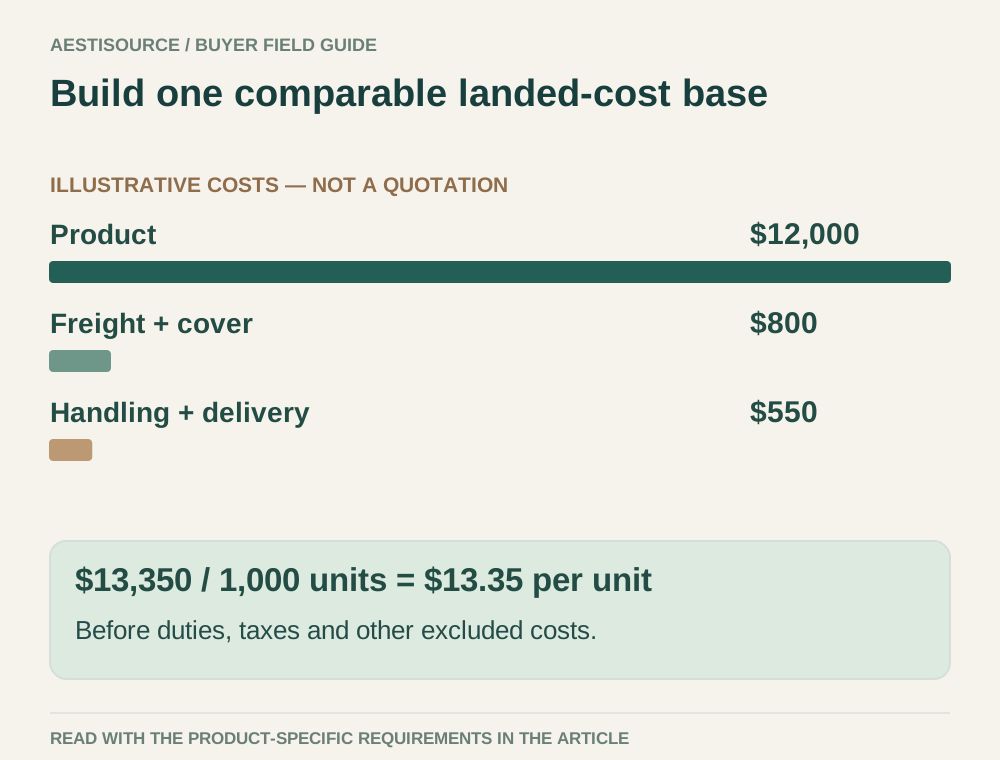
Assume a hypothetical order of 1,000 saleable units with USD 12,000 in product cost, USD 800 in freight and cover, and USD 550 in handling and final delivery. These invented figures illustrate the arithmetic only; they are not AestiSource prices, a tariff estimate or a shipping quote.
The subtotal is USD 13,350, or USD 13.35 per unit before any applicable duties, taxes and other excluded costs. Each missing cost should remain an open line rather than being assigned zero without evidence.
Now suppose the commercial plan reserves 20 units for non-saleable evaluation or other purposes. If the business chooses to allocate the entire subtotal across the remaining 980 units, the planning figure becomes about USD 13.62 each. That accounting scenario does not describe actual damage or an expected rejection rate; it simply shows why the denominator must be stated.
Use the same convention for competing quotations. Otherwise one supplier may appear cheaper because the worksheet spreads its costs over units that the sales plan will not sell.
What should remain outside the price calculation?
Product suitability, market access and unresolved quality evidence should remain separate decision gates. They should not disappear inside a weighted cost score. An apparently economical delivery arrangement does not repair missing product documentation or authorize a restricted import.
Similarly, keep cash timing visible. A recoverable tax may still create a funding requirement, and a deposit can tie up cash before the shipment arrives. The treatment depends on the actual jurisdiction and accounting position; avoid applying a generic recovery assumption.
For the operational transport questions, use the shipping and cold-chain guide. The cost worksheet should reference that agreed route and service scope, not introduce a different handling assumption to make the numbers look better.
Ask for a comparable revised quote
Send the supplier the same product configuration, quantity basis, delivery point and requested exclusions list used for every offer. Ask it to identify assumptions rather than simply matching a competitor’s total.
A clear comparison ends with a cost range where uncertainty remains, the inputs awaiting confirmation and the date until which each quote is valid. That gives the purchasing team a decision it can explain and update when the shipping plan or order changes.
Put the named delivery place, exclusions and quotation units into the HA product RFQ specification so the next round of offers uses the same assumptions.
Frequently Asked Questions
Does a delivered quote establish that a product can be imported?
No. Delivery scope and product market access are separate questions. Confirm the product’s admissibility, responsible importer and required documents for the destination before placing an order.
Should recoverable import tax be ignored?
Keep it visible in the cash-flow plan even if your accounting treatment later allows recovery. Show economic cost and cash required separately, using the actual local tax treatment rather than assuming every tax is recoverable.
Sources
- Incoterms 2020 — International Chamber of Commerce
- Incoterms 2020: CFR vs FOB and the title transfer myth — ICC Academy