

Table of Contents
Quick answer
For devices subject to UDI requirements, distinguish the device identifier from production information such as lot or expiry. Store the applicable identifiers alongside internal SKU, quantity and movement records. A database match helps identify a device; it does not authenticate an individual unit or establish market authorization.
Imagine trying to locate one lot after a supplier query. Your warehouse can search by product name and customer, but every receipt was booked under a short internal SKU. The cartons were scanned, yet the lot field was never saved. The scanner worked; the record design did not.
UDI, lot and expiry traceability starts with a deliberate mapping between what is on the label and what the receiving, picking and dispatch processes retain.
What is the difference between a device identifier and a lot?
Under the US framework, FDA’s UDI Basics distinguishes the fixed device identifier, which identifies the labeler and version or model, from conditional production information such as lot, serial number and dates. The applicable content depends on the device and label. Exceptions and alternatives exist; this is not a statement that every aesthetic product worldwide carries the same UDI fields.
Treat these as different data purposes. A product-level identifier helps distinguish models. A lot connects units to a production grouping. An expiry date supports stock decisions. Storing them as one free-text description makes later searches harder.
Which UDI, lot and expiry fields belong in the receiving record?
Design the record around the questions a later investigation would ask. The table below is an operational model, not a claim that every field is mandatory in every jurisdiction.
| Field group | Suggested contents | Later question it helps answer |
|---|---|---|
| Commercial reference | Internal SKU, supplier, purchase order | What did we intend to buy? |
| Device identity | Manufacturer reference and applicable device identifier | Which exact version did we receive? |
| Production identity | Lot/serial and relevant dates from the label | Which units belong to the affected group? |
| Quantity and units | Cartons, packs and units with conversion defined | How many units are involved? |
| Location and status | Bin, hold/released status and movement date | Where is the stock now? |
| Dispatch link | Shipment, recipient and quantities by lot | Where did the stock go? |
Avoid automatically replacing a manufacturer reference with a normalized name if that loses a variant. Keep the original value and an explicit cross-reference. The same principle applies to dates: preserve the source value and document how software interprets it.
How do you test scanning before a full rollout?
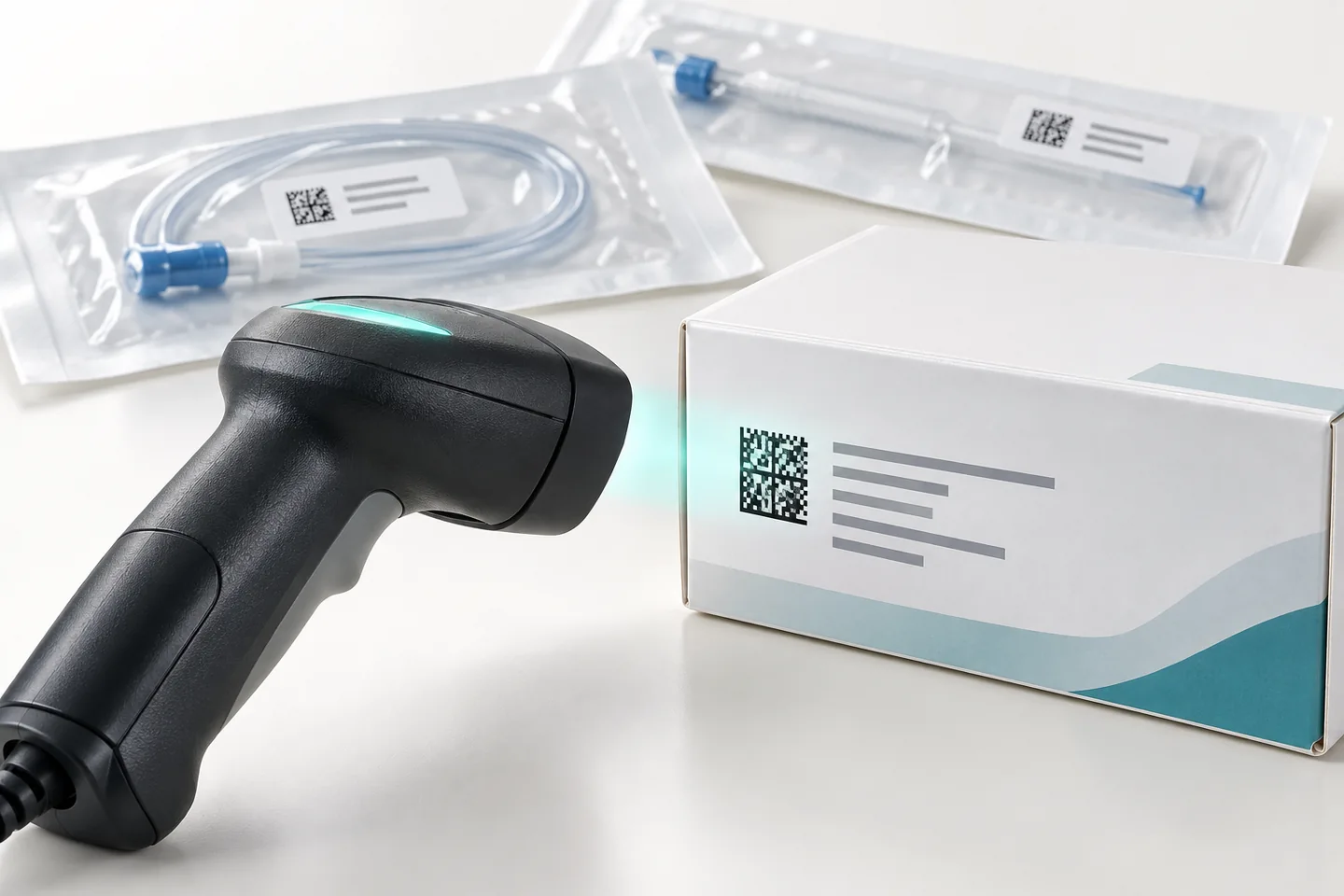
Use representative labels from the actual pack levels you handle, then compare scanned output with visible information. A scanner displaying a string does not prove that the warehouse software assigned each element to the correct field.

A parcel’s delivery label is not automatically a device identifier; verify which code your workflow is reading.
GS1’s UDI guidance explains how its identifiers and application identifiers are used for device and production data. If the supplier uses that system, test parsing accordingly; do not assume every two-dimensional symbol uses the same syntax.
A useful trial includes a normal receipt, two lots of the same SKU, a partial dispatch and a return placed on hold. After those movements, ask a colleague to retrieve the remaining quantity and recipients for one specified lot. Compare the answer with the source transactions. This tests the workflow rather than only the hardware.
What does a database match leave unresolved?
It leaves questions about the individual shipment, unit authenticity and applicable authorization to be answered through the appropriate evidence. FDA notes that GUDID stores device identifier data, not production identifiers. A matching record therefore cannot establish the history of the carton on your desk.
Keep market-access verification separate from inventory data capture. Similarly, an internal barcode generated by a warehouse is not evidence of a manufacturer’s regulatory status. Use the regulatory resources to frame document requests and confirm the specific product and destination requirements.
Make exceptions searchable too
A damaged label, unreadable symbol or conflicting date should create an exception record linked to the stock, rather than an improvised replacement identifier. Record the observation, hold status and request for clarification. If the supplier provides a correction, preserve both the original record and its resolution.
The objective is a reconstructable chain from receipt to dispatch. A simple system that retains accurate lot-level movements can be more useful than a sophisticated scanner connected to incomplete fields. Review the process when pack formats, identifiers or warehouse software change, and test it before the next large order rather than during a real complaint.
Use the retained expiry fields for remaining shelf-life planning, and test the dispatch links through a complaint and lot reconciliation.
Frequently Asked Questions
Does AccessGUDID show whether a particular lot is genuine?
No. FDA explains that GUDID contains device identifier information, not production identifiers for individual lots. Use the manufacturer’s traceability and authenticity channels for lot-specific questions.
Can internal SKUs replace the identifiers printed on a device?
Keep internal SKUs for your own operations, but retain the applicable manufacturer and production identifiers as separate fields. A cross-reference lets staff work with familiar codes without losing the original identity.
Sources
- UDI Basics — U.S. FDA
- Unique Device Identification (UDI) — GS1