

Table of Contents
- 1. Why Does Orthopedic HA Need a Different Sourcing Approach?
- 2. What Are the Structural Differences Between Intra-Articular HA and Aesthetic Gels?
- 3. How Do You Verify Molecular Weight, Concentration, and Volume Specifications?
- Specification Capture Template
- 4. What Sterile Prefilled Syringe Configurations Should You Specify?
- 5. How Do You Manage Batch, Lot, and Shelf-Life Records?
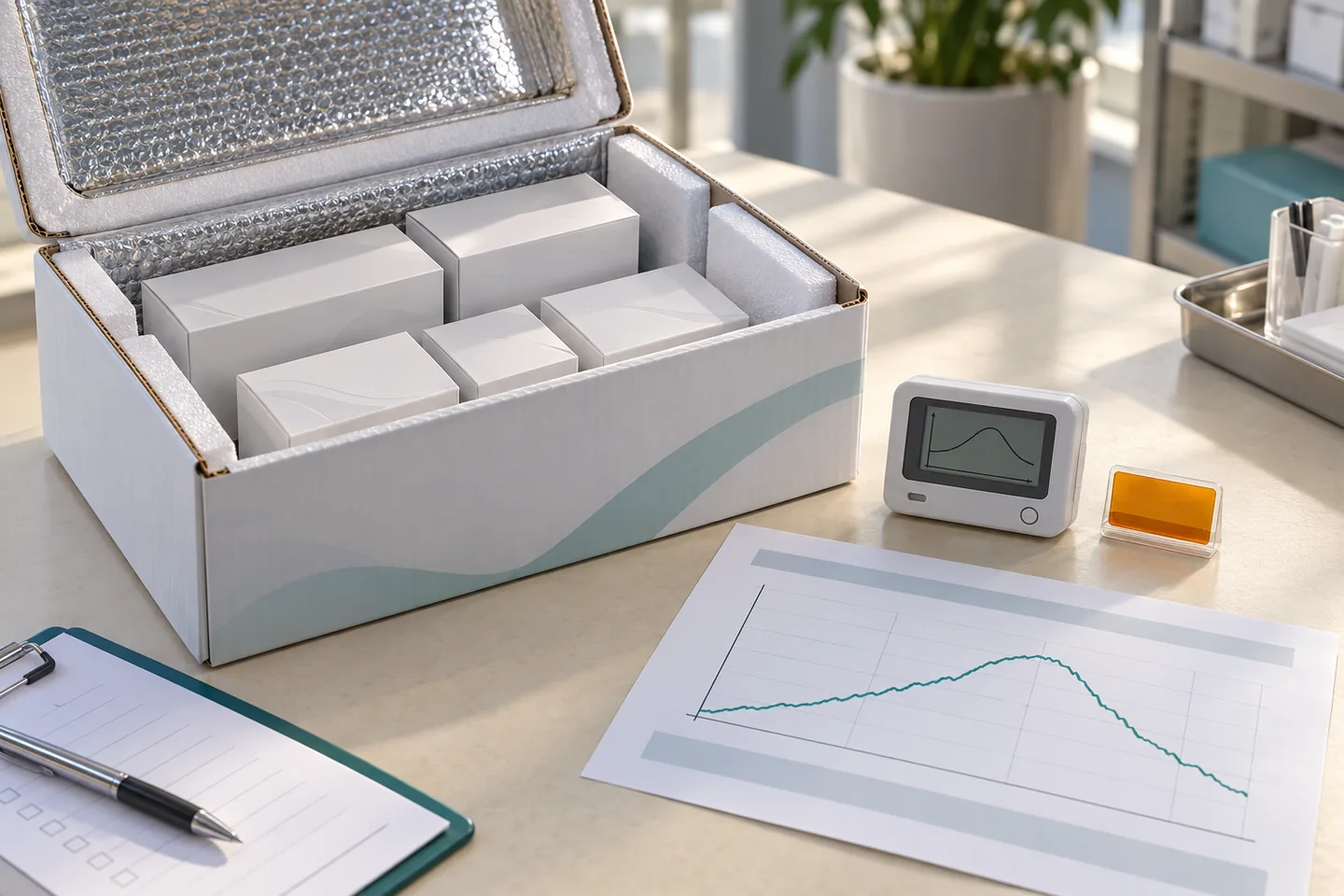
- 6. What Cold Chain and Storage Requirements Apply?
- 7. How Do You Build a Supplier Qualification Checklist?
- 8. Why Should Orthopedic Procurement Sit Outside the Aesthetic Category?
- 9. Procurement Recommendations
Quick answer
An intra-articular HA supplier should be selected on orthopedic-specific criteria, not aesthetic-filler criteria: non-crosslinked rather than cross-linked chemistry, a declared molecular weight and mg-per-ml concentration, sterile prefilled syringe formats in 2ml / 3ml / 4ml volumes, and a batch documentation chain that reconciles lot numbers across the invoice, packing list, and Certificate of Analysis. Verify the supplier's ISO 13485 scope and CE certificate explicitly cover non-active joint implants — a dermal-filler certificate does not.
Why Does Orthopedic HA Need a Different Sourcing Approach?
Intra-articular hyaluronic acid is a sterile, non-crosslinked polymer preparation supplied in prefilled syringes. It shares a base molecule with aesthetic fillers, and almost nothing else. Where a dermal filler is engineered around cross-linking density and gel firmness, an orthopedic preparation is engineered around molecular weight, concentration, and syringe fill accuracy.
For distributors and hospital procurement teams, that difference shows up in three practical places:
- Specification language: concentration is quoted per syringe at a declared molecular weight, not as a gel grade.
- Documentation: the technical file is oriented toward joint device classification, not aesthetic implant classification.
- Channel: the end buyer is a clinician-requisitioned or tender-driven procurement line, with different ordering rhythm and different lot-traceability expectations.
Industry analysts tracking the viscosupplementation category, including Future Market Insights and Mordor Intelligence, continue to describe it as a distinct medical device segment rather than an aesthetic sub-category. Distributor catalogue structure should follow the same logic.
What Are the Structural Differences Between Intra-Articular HA and Aesthetic Gels?
Buyers who source both categories often assume a supplier qualified for one is qualified for the other. The specification sets do not overlap cleanly:
| Parameter | Intra-Articular HA | Cross-Linked Dermal Filler |
|---|---|---|
| Cross-linking | Non-crosslinked | Chemically cross-linked (e.g. BDDE) |
| Source | Non-animal, fermentation-derived | Non-animal, fermentation-derived |
| Key spec | Molecular weight + mg per syringe | Gel grade + cross-linking density |
| Concentration basis | mg per syringe at a stated volume | mg/ml of gel |
| Format | Sterile prefilled syringe, 1ml–5ml series | Prefilled syringe, typically 1ml |
| Typical storage | Manufacturer-declared, often controlled ambient | Manufacturer-declared, often controlled ambient |
| Regulatory route | Non-active joint / implantable device scope | Injectable implant scope (Class III under EU MDR) |
| Primary channel | Hospital, orthopedic, tender-driven | Clinic, aesthetic distribution |
The most common procurement failure is accepting a CE certificate whose scope wording references dermal fillers or soft tissue augmentation while the shipped goods are joint devices. Those are separate technical files.
How Do You Verify Molecular Weight, Concentration, and Volume Specifications?
Three specifications drive the SKU structure, and each must be captured separately on the requisition line:
- Molecular weight: declare the range or nominal figure the manufacturer specifies in the technical file. Do not accept “high molecular weight” as a standalone descriptor without a numeric range.
- Concentration: express as mg per syringe against a stated volume, for example 30mg in 3ml or 45mg in 3ml. The same 3ml syringe may exist at multiple strengths.
- Volume: 1ml, 2ml, 3ml, 4ml, and 5ml are common formats. The commercially significant orthopedic formats are 2ml, 3ml, and 4ml.
Specification Capture Template
| Field | Example Entry | Source Document |
|---|---|---|
| Molecular weight | Manufacturer-declared range | Technical file |
| Concentration | mg per syringe at stated volume | COA / technical file |
| Fill volume | 2ml / 3ml / 4ml | Carton + COA |
| Syringe format | Sterile prefilled, luer or fixed needle | Artwork + sample |
| Shelf life | Manufacturer-declared, e.g. 24 months | COA / carton |
| Sterility method | Manufacturer-declared | Technical file |
Practical rule: if the concentration is stated only in mg/ml and the syringe volume is stated only on the carton, the two documents must reconcile. A mismatch between carton net fill and COA concentration is a documentation defect, not a rounding issue.
What Sterile Prefilled Syringe Configurations Should You Specify?
Orthopedic HA is supplied as a ready-to-use sterile prefilled syringe. Four configuration points belong in the purchase specification:
- Fill volume accuracy: require a declared net fill and tolerance, and spot-check against the packing list.
- Closure system: confirm the needle or luer configuration, and whether a separate administration set is required for the channel you serve.
- Sterile barrier: the syringe plus the carton is the sterile barrier system. Any transit damage that compromises the blister or pouch invalidates the sterility claim.
- Artwork and language: national language labelling requirements vary by market. Specify the label set before the print run, not after.
Sourcing the orthopedic HA range for a hospital or tender channel?
AestiSource supplies the 2ml, 3ml, and 4ml non-crosslinked intra-articular formats with full batch documentation for licensed distributors.
How Do You Manage Batch, Lot, and Shelf-Life Records?
Batch control is where orthopedic channel buyers carry more exposure than aesthetic buyers, because hospital receiving departments expect lot traceability to be immediate and complete. Every shipment should arrive with a documentation set that reconciles on four fields: lot number, manufacturing date, expiry date, and quantity.
| Document | Must Contain | Reconciles Against |
|---|---|---|
| Commercial invoice | HS code, declared value, units | Purchase order |
| Packing list | Lot numbers, expiry dates per carton | Invoice |
| Certificate of Analysis | Lot number, concentration, sterility result | Packing list |
| Certificate of Origin | Consignment reference | Invoice |
Set a receiving rule and hold it: no lot number on the packing list means no goods receipt. Retrofitting a lot number after the goods are in the warehouse defeats the traceability chain entirely.
On shelf life, apply a residual-life floor at receipt rather than at order. A common distributor standard is a minimum remaining shelf life — frequently expressed as a percentage of total shelf life — measured at the receiving dock, not at the supplier’s dispatch date.
What Cold Chain and Storage Requirements Apply?
Storage specification is set by the manufacturer and printed on the carton and technical file. Intra-articular HA formulations are frequently declared for controlled ambient storage, with a ceiling commonly stated at or below 25°C, while some non-crosslinked formats specify refrigerated storage in the 2°C to 8°C band.
Confirm which applies before you place the order, because it determines the shipped packaging:
| Declared Storage | Packaging Requirement | In-Transit Evidence |
|---|---|---|
| Controlled ambient (e.g. ≤25°C) | Insulated shipper sized to route and season | Optional data logger |
| Refrigerated (2°C–8°C) | Validated insulated shipper plus phase change material | Mandatory temperature logger |
Where a refrigerated range is declared, the qualification question is not “was coolant used” but “was the qualified pack-out configuration used for this route and this transit duration”. That is a supplier-side validation document you can request.
How Do You Build a Supplier Qualification Checklist?
Build the checklist around evidence, not assurances. Each line item should map to a document you can retain in the supplier file.
- ISO 13485 certificate — confirm the scope wording names non-active surgical implants or joint devices, not only soft tissue devices.
- CE certificate with Notified Body number — verify the Notified Body is active and designated for the relevant device scope.
- Product technical file summary — confirms chemistry (non-crosslinked), molecular weight, and concentration basis.
- Batch Certificate of Analysis — lot-specific, and matched to the shipment.
- Air transport test report — confirms the HA gel classification for air movement.
- Sterility and packaging validation — supports the sterile barrier claim through transit.
- Artwork and labelling samples — checked against destination market requirements.
- Deviation and recall procedure — a named contact, a written escalation path, and a stated response window.
Aesthetic category suppliers are often qualified on a lighter checklist. Applying that same lighter checklist to the orthopedic range is the single most common qualification gap we see in distributor files.
Why Should Orthopedic Procurement Sit Outside the Aesthetic Category?
Treat intra-articular HA as its own supplier category, with its own approved-vendor record, for four reasons:
- Different buyer: orthopedic and hospital procurement operates on requisition and tender cycles rather than clinic reorder cycles.
- Different documentation bar: joint-device technical files and clinical requisition paperwork are not interchangeable with aesthetic supply records.
- Different volume logic: the 2ml / 3ml / 4ml series maps to a different demand curve than 1ml aesthetic syringes.
- Different risk ownership: a documentation defect in the orthopedic channel surfaces at hospital receiving, where corrective action is slower and more formal.
Folding both categories under one supplier record means a single qualification decision is being used to justify two unrelated risk profiles. Split the records.
Procurement Recommendations
For distributors and hospital procurement teams building an intra-articular HA supply line:
- Specify on chemistry, not on category. Non-crosslinked, declared molecular weight, mg per syringe at a stated volume.
- Stock by concentration and volume combination. 2ml, 3ml, and 4ml at multiple strengths are distinct SKUs.
- Require batch documentation that reconciles on four fields. Lot, manufacturing date, expiry date, quantity.
- Confirm the storage declaration before ordering. It determines the packaging configuration and the need for a temperature logger.
- Qualify on orthopedic scope. An ISO 13485 certificate and CE certificate scoped to dermal fillers does not cover a joint device.
- Hold the receiving rule. No lot number on the packing list, no goods receipt.
AestiSource supplies non-crosslinked intra-articular hyaluronic acid in sterile prefilled syringe formats for licensed distributors, with batch documentation, air transport reports, and market-specific labelling support available on request.
Frequently Asked Questions
Is intra-articular HA the same material as a dermal filler?
No. Intra-articular hyaluronic acid is typically non-crosslinked, sterile, and produced to a declared molecular weight in mg/ml terms. Cross-linked dermal fillers are chemically modified gels whose stability depends on cross-linking density. The two materials have different viscosity profiles, different packaging, and different regulatory classification routes. A supplier competent in one category is not automatically qualified for the other.
What volume formats should a distributor stock for the orthopedic channel?
Most orthopedic ranges are offered as a 1ml to 5ml series, with 2ml, 3ml, and 4ml as the commercially significant formats. Concentration varies within the same volume — a 3ml syringe may be offered at several mg-per-syringe strengths. Stock by concentration-and-volume combination, not by volume alone, so that each SKU maps to a distinct requisition line.
Does intra-articular HA require cold chain shipping?
Non-crosslinked HA formulations generally tolerate controlled ambient conditions, but the storage specification is set by the manufacturer and printed on the technical file and carton. Confirm whether the declared range is controlled ambient (commonly up to 25°C) or refrigerated (2°C to 8°C). Where refrigerated storage is declared, the shipment needs validated insulated packaging and a temperature record.
What is the minimum supplier documentation set for an orthopedic HA order?
At minimum: ISO 13485 certificate with scope wording that names non-active implants or joint devices; a CE certificate with a Notified Body number; a batch-specific Certificate of Analysis; a Certificate of Origin; an air transport test report for the HA gel; and a packing list that carries lot numbers and expiry dates matching the COA.
Why should orthopedic procurement sit in a separate category from aesthetic fillers?
The buyer is different (hospital and orthopedic channel versus clinic), the documentation bar is different (clinical requisition and tender documentation versus aesthetic supply), and the storage and shelf-life handling is different. Managing both under one supplier record means one qualification decision is being used to justify two unrelated risk profiles.
Products referenced in this guide
Sources
- Viscosupplementation Market Report — Future Market Insights (2026-01-01)
- Viscosupplementation Market Size, Share and Industry Analysis — Mordor Intelligence (2026-01-01)