

Table of Contents
- 1. Why Does Volume Decide More Than Price?
- 2. What Is the Body Filler Volume Specification Ladder?
- 3. How Do You Map Volume to Procedure-Scale Requisition?
- Order Sizing Worksheet
- 4. What Delivery Systems Should You Specify for Vendor Formats?
- 5. What Packaging and Freight Configurations Apply to Large Volumes?
- Cartonisation
- Air Freight
- Consignment Documentation
- 6. How Do You Handle Storage and Shelf Life for Bulk Formats?
- 7. Procurement Recommendations
Quick answer
Body filler volume is a packaging decision first and a capacity decision second. The commercial formats are 10ml, 20ml, 50ml, and 100ml — typically supplied as multi-dose vials for the largest sizes and as 10ml or 20ml fills at the smaller end. Select the format by procedure-scale requisition and freight economics, not by unit price alone: a 100ml vial carries a lower cost per ml but concentrates shelf-life risk, while a 10ml fill trades unit economics for faster turnover and lower waste.
Why Does Volume Decide More Than Price?
The large volume hyaluronic acid category is reported as one of the fastest-growing segments within the wider dermal filler market by Grand View Research, and the growth is concentrated in formats above the classic 1ml syringe. That shift changes what a distributor is actually buying.
A 1ml aesthetic syringe is a single-use unit with predictable freight, predictable storage, and predictable expiry. A 100ml vial is a bulk container: lower cost per ml, but a single container now carries the value of a hundred syringes, and its entire volume expires on one date.
Procurement decisions in this category therefore hinge on four levers: fill volume, concentration, container format, and freight configuration.
What Is the Body Filler Volume Specification Ladder?
The commercial formats across body filler ranges are 10ml, 20ml, 50ml, and 100ml. Each occupies a different position on the trade-off curve:
| Format | Typical Container | Concentration Basis | Procure When | Watch For |
|---|---|---|---|---|
| 10ml | Vial or syringe-compatible fill | ~26mg/ml class | Lower throughput, mixed requisitions, faster turnover | Highest cost per ml |
| 20ml | Vial or large-barrel fill | ~26mg/ml class | Mid-volume channel with mixed SKU demand | Moderate cost per ml; confirm delivery system |
| 50ml | Multi-dose vial | ~26mg/ml class | Established volume channel with regular requisition | Longer shelf-life exposure per unit |
| 100ml | Multi-dose vial | ~26mg/ml class | High throughput, few large requisitions | Entire vial expires on one date |
Note on concentration: high density cross-linked HA body fillers are commonly formulated at approximately 26mg/ml, but concentration should always be confirmed for the specific product rather than assumed. Volume and concentration are independent fields, and both belong on the purchase order.
How Do You Map Volume to Procedure-Scale Requisition?
Volume selection is a demand-planning exercise, not a clinical one. The question is how much material a given market draws per requisition period.
Order Sizing Worksheet
| Step | Input | Example Basis |
|---|---|---|
| 1 | Estimated ml per session | Agreed figure for your market |
| 2 | Expected sessions per month | Internal forecast |
| 3 | Monthly ml requirement | Step 1 × Step 2 |
| 4 | Safety stock buffer | Add a percentage of Step 3 |
| 5 | Required monthly ml | Step 3 + buffer |
| 6 | Vials per month | Step 5 ÷ fill volume |
| 7 | Shelf-life check | Does one cycle fit inside residual shelf life? |
Two failure modes emerge from this worksheet:
- Over-ordering the largest format: a 100ml vial carries the lowest cost per ml, but if monthly throughput is small, the vial sits in inventory and approaches expiry before it is exhausted. The unit-economics advantage is then consumed by write-off.
- Under-ordering the largest format: a high throughput channel running on 10ml fills pays a cost-per-ml premium and processes far more containers, increasing handling and freight overhead per ml.
The correct answer is almost always a mixed range: the largest format that your turnover can absorb, plus a smaller format that lets you fulfil partial or low-volume requisitions without opening bulk stock.
What Delivery Systems Should You Specify for Vendor Formats?
Container format and delivery system are two separate specification lines. A vial is not simply a large syringe.
- Vial formats: require a compatible transfer or aspiration system at the point of use. Specify the closure type, septum configuration, and the transfer accessories you intend to supply alongside. If a distributor supplies the vial without confirming the accessory ecosystem, the downstream user is left to source compatibility independently.
- Large-barrel and syringe-compatible fills: specify the barrel material, plunger configuration, and connector type. Confirm the connector matches the cannula or needle system used in your market.
- Accessory bundling: for 50ml and 100ml formats, accessory kits are frequently a separate line item. Price them separately so that landed cost per ml reflects the full delivered configuration.
| Container | Closure / Connector to Confirm | Accessory Bundle |
|---|---|---|
| 10ml vial | Septum type, cap configuration | Transfer device |
| 20ml vial | Septum type, cap configuration | Transfer device |
| 50ml multi-dose vial | Septum type, cap configuration | Transfer device, drawing accessories |
| 100ml multi-dose vial | Septum type, cap configuration | Transfer device, drawing accessories |
| Syringe-format fill | Luer / connector type | Cannula compatibility |
What Packaging and Freight Configurations Apply to Large Volumes?
Large-format body filler is heavy, bulky, and higher value per carton than a 1ml assortment. Three logistics consequences follow.
Cartonisation
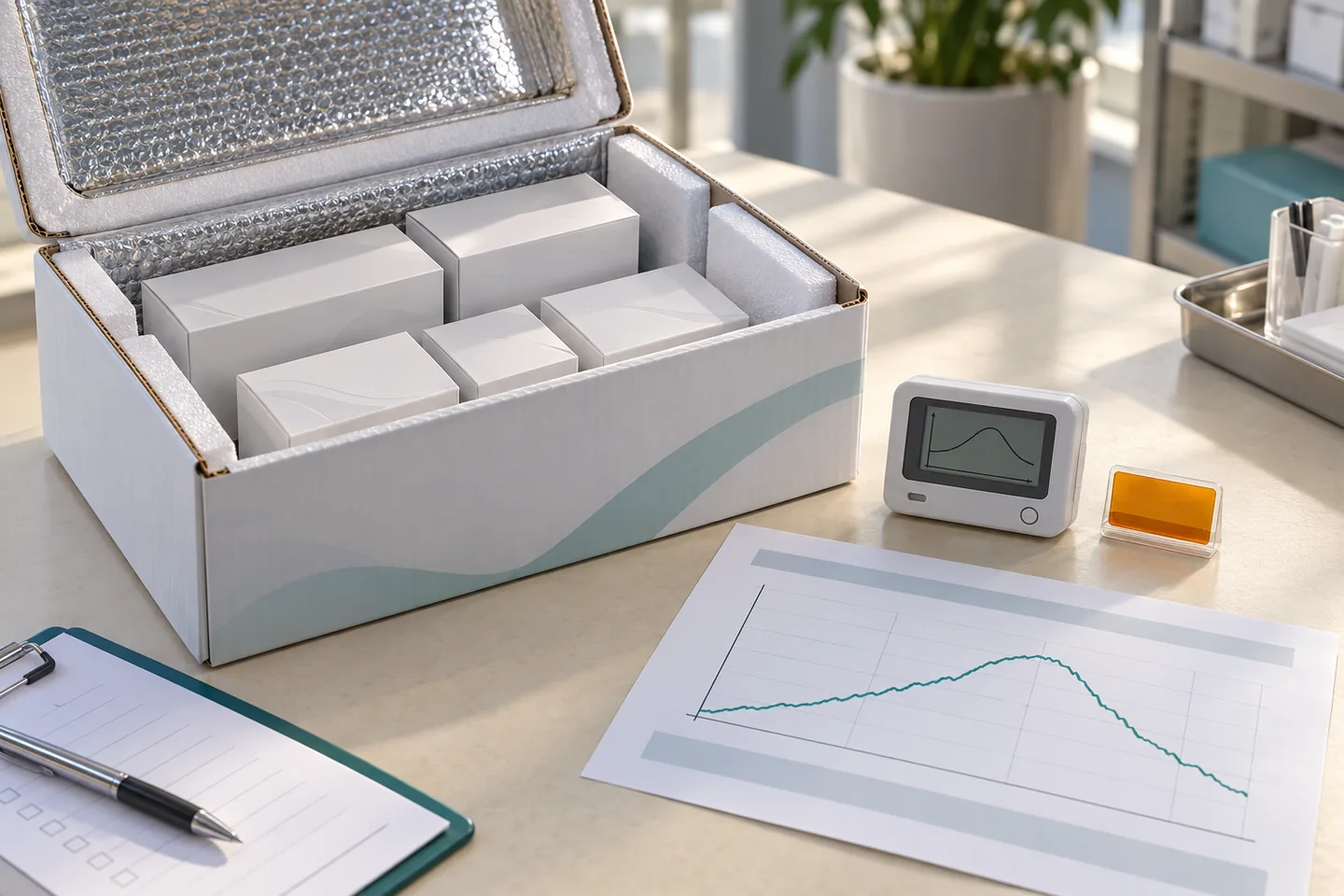
Bulk vials need secondary packaging that resists compression and protects the closure system, not just the glass or plastic body. Specify the carton configuration for the largest format you intend to import, and require a transit test report where the format is new to your route.
Air Freight
The classification question is the same as for any HA gel: whether the formulation, the volume per container, and the total consignment trigger dangerous goods handling. Volumes at the 100ml scale change the quantity-per-container reality, which can affect the classification treatment of a shipment even where the gel chemistry is unchanged. Obtain the transport classification document from the manufacturer for the specific format being shipped, not for the product family in general.
Consignment Documentation
| Document | Must Show |
|---|---|
| Commercial invoice | Correct HS code, declared value, unit count by format |
| Packing list | Lot numbers, expiry dates, net fill per container |
| Certificate of Origin | Consignment reference |
| Certificate of Analysis | Lot-specific concentration and volume |
| Air transport classification | Format-specific gel classification |
Ship high-volume consignments directly to a pharmacy or licensed wholesale address, with an unbroken chain from the supplier’s dispatch lot record to your goods receipt.
Building a large volume body filler line for a distribution channel?
AestiSource supplies 10ml, 20ml, 50ml, and 100ml body filler formats with batch documentation, transport classification reports, and OEM labelling options.
How Do You Handle Storage and Shelf Life for Bulk Formats?
Storage specification is set by the manufacturer and stated in the technical file and on the carton. Do not infer it from gel chemistry.
| Declared Storage | Packaging | In-Transit Evidence |
|---|---|---|
| Controlled ambient | Insulated shipper, compression-resistant cartons | Optional data logger |
| Refrigerated | Validated insulated shipper plus phase change material | Mandatory temperature logger |
Shelf-life management differs structurally from small formats. With 1ml units, expiry risk is spread across many small containers and a partial write-off is limited. With a 100ml vial, expiry risk is concentrated. Apply these controls:
- Residual-life floor at receipt: express as a minimum permitted remaining shelf life measured at your goods-in dock.
- FIFO by lot, enforced physically: the oldest lot must be the most accessible, or bulk formats will silently expire.
- Per-lot expiry reporting: run a monthly report listing every open lot with remaining shelf life, and treat near-expiry bulk stock as an escalation item rather than a reporting line.
- Format-matched ordering: reserve the largest format for SKUs with the most predictable turnover; use smaller fills for irregular demand.
Procurement Recommendations
For distributors and importers assembling a body filler range:
- Specify volume and concentration together. ~26mg/ml is a common class figure for high density cross-linked HA body fillers, but confirm per product.
- Carry a mixed format range. The largest format your turnover can absorb, plus a smaller fill for partial requisitions.
- Confirm the delivery system separately from the container. Vial closure type, transfer accessories, and connector compatibility are distinct specification lines.
- Size orders from requisition, not from unit price. Work the ml-requirement worksheet before choosing a format.
- Get format-specific transport classification. The classification applies to the shipped configuration, not the product family.
- Manage bulk expiry physically, not procedurally. FIFO enforced at the rack, with a monthly open-lot expiry report.
AestiSource supplies high density cross-linked HA body filler across 10ml, 20ml, 50ml, and 100ml formats for licensed distributors, with batch documentation, transport classification reports, and OEM labelling available on request.
Frequently Asked Questions
What concentrations are standard for large volume body fillers?
High density cross-linked hyaluronic acid body fillers are commonly formulated at approximately 26mg/ml. Concentration is a separate specification from volume — the same 50ml format may be offered at more than one concentration. Capture both fields on the requisition line, because price per ml is driven by concentration as much as by fill volume.
What is the difference between a body filler vial and a prefilled syringe format?
A vial is a multi-dose container that requires a compatible transfer or aspiration system at the point of use; a prefilled syringe is a single-use delivery format. Vials suit the larger 50ml and 100ml volumes because syringe barrels at that scale are impractical to ship and store. Smaller fills in the 10ml and 20ml range are frequently supplied as syringe-format or syringe-compatible units.
What freight documentation is required for a 100ml body filler shipment?
For air movement: an air transport test report or transport classification document for the HA gel, a commercial invoice carrying the correct HS code, a packing list showing lot numbers and expiry dates, a Certificate of Origin, and a batch Certificate of Analysis. Where any component triggers dangerous goods classification, the applicable packing instruction and shipper declaration apply. Confirm the classification with the manufacturer before booking freight.
How should a distributor estimate order quantity for large volume fillers?
Work back from procedure-scale requisition rather than from historical unit sales. Establish a typical ml-per-session figure for your market, multiply by expected sessions per period, then apply a safety stock buffer and a residual shelf-life floor. Because large vials concentrate expiry risk, order the largest format only where the volume throughput justifies it.
Do large volume body fillers need cold chain shipping?
Storage specification is set by the manufacturer and stated in the technical file and on the carton. Cross-linked HA gels are frequently declared for controlled ambient storage, but the declared range must be confirmed per product rather than assumed from gel chemistry. Where a refrigerated range is declared, the shipment requires validated insulated packaging and a temperature record.
Products referenced in this guide
Sources
- Hyaluronic Acid-Based Dermal Fillers Market Analysis — Grand View Research (2026-01-01)